Learner Safety
Make room for questions, mistakes, feedback, and the work of learning something new.

Understand the four quadrants. Develop the behaviors that help people contribute, challenge, and grow.
Understand the four quadrants. Develop the behaviors that help people contribute, challenge, and grow.
Create the conditions for contribution
Meetings are quiet. Concerns surface too late. People hesitate to ask questions or challenge a decision. Leading with Psychological Safety helps leaders identify behaviors that discourage participation and practice inviting input, responding constructively to mistakes, and making room for different perspectives.
People contribute more openly when they feel able to ask questions, learn from mistakes, offer ideas, and challenge the status quo. Leading with Psychological Safety helps leaders recognize the everyday behaviors that make those moments safer—and the habits that can shut them down.
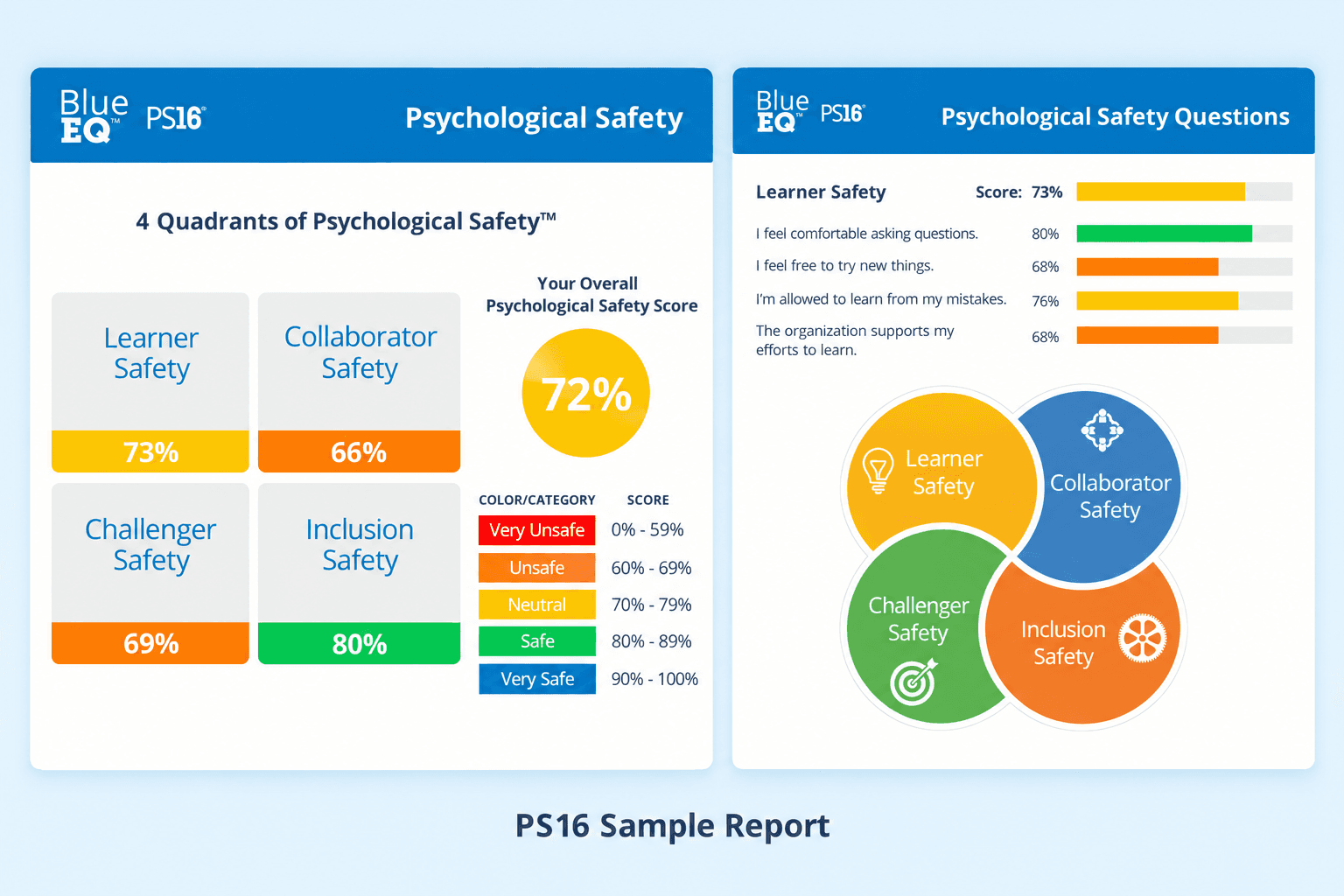
Explore each quadrant through assessment insights, interactive discussion, and practical workplace situations. Learn to notice behaviors that increase or decrease psychological safety, then choose specific changes to the way you invite input, respond to mistakes, handle challenge, and include others.
Build a development plan you can put into practice with your team. The course connects understanding with action, supported by course activities and The BlueEQ Academy resources. Attend a public workshop or talk with BlueEQ about a private session for your organization.
Explore each quadrant and the specific behaviors that can increase or decrease safety.
Make room for questions, mistakes, feedback, and the work of learning something new.
Help people share ideas, contribute their strengths, and work together with confidence.
Create space to raise concerns, question assumptions, and challenge ideas constructively.
Build everyday interactions in which people feel respected, included, and able to belong.
Measure
Use assessment insights to examine psychological safety and identify where development can make a difference.
Explore a cultural assessment →Develop
Work through interactive exercises, conversations, and course activities. Recognize behaviors in each quadrant and practice more effective responses.
Sustain
Put your development plan into practice with your team. Use peer coaching and The BlueEQ Academy to reflect on your experiences and keep developing.
The way people manage their emotions and relationships affects whether others feel safe to contribute. Connect emotional intelligence with psychological safety, then translate that connection into specific leadership behaviors.
Explore Leading with Emotional Intelligence →Arrange a private Leading with Psychological Safety workshop for your team, delivered in person or live online. Explore inclusion safety, learner safety, collaborator safety, and challenger safety together, and examine the everyday behaviors that increase or decrease psychological safety in your workplace.
Talk with BlueEQ about coaching support to turn your development priorities into everyday practice.
Explore CoachingClient perspectives on creating a safer, more supportive workplace.
“The workshop is not only insightful, but entertaining! The 4 hours flew by with engaging conversations, collaborative projects and thought provoking questions that resulted in being able to walk away with tangible takeaways to improve psychological safety.”
“BlueEQ’s training helps you gain clarity on what different segments of Psychological Safety are, how they may be damaged, and how to repair them. The training isn’t just talking at you, it is a hands-on, participative training to help you put what you learn into an action plan for improvement.”
“I think every company should invest in BlueEQ and I am grateful that Lovesac invests time in a program that helps improve our emotional intelligence and psychological safety. I think it is a vital part of a healthy workplace and when the company takes time to invest in its people it makes for a stronger community and an environment that encourages growth and longevity in the team!”
Join a public workshop, bring a private course to your team, or become a certified facilitator.
Psychological safety describes whether people feel able to ask questions, contribute ideas, acknowledge mistakes, and challenge the status quo without fear of humiliation or retaliation. It supports candid conversations, learning, and teamwork.
The BlueEQ framework includes Learner Safety, Collaborator Safety, Challenger Safety, and Inclusion Safety. The course explores the behaviors that increase or decrease safety in each quadrant.
The PS16 Cultural Assessment measures how people experience psychological safety across the four quadrants. BlueEQ helps determine assessment scope and reporting needs, then connects insights with a practical development plan. Request a custom quote.
Create the conditions for contribution
Meetings are quiet. Concerns surface too late. People hesitate to ask questions or challenge a decision. Leading with Psychological Safety helps leaders identify behaviors that discourage participation and practice inviting input, responding constructively to mistakes, and making room for different perspectives.
People contribute more openly when they feel able to ask questions, learn from mistakes, offer ideas, and challenge the status quo. Leading with Psychological Safety helps leaders recognize the everyday behaviors that make those moments safer—and the habits that can shut them down.
Explore each quadrant through assessment insights, interactive discussion, and practical workplace situations. Learn to notice behaviors that increase or decrease psychological safety, then choose specific changes to the way you invite input, respond to mistakes, handle challenge, and include others.
Build a development plan you can put into practice with your team. The course connects understanding with action, supported by course activities and The The BlueEQ Academy resources. Attend a public workshop or talk with BlueEQ about a private session for your organization.
Explore each quadrant and the specific behaviors that can increase or decrease safety.
Make room for questions, mistakes, feedback, and the work of learning something new.
Help people share ideas, contribute their strengths, and work together with confidence.
Create space to raise concerns, question assumptions, and challenge ideas constructively.
Build everyday interactions in which people feel respected, included, and able to belong.
Measure
Use assessment insights to examine psychological safety and identify where development can make a difference.
Explore a cultural assessment →Develop
Work through interactive exercises, conversations, and course activities. Recognize behaviors in each quadrant and practice more effective responses.
Sustain
Put your development plan into practice with your team. Use peer coaching and The The BlueEQ Academy to reflect on your experiences and keep developing.
The way people manage their emotions and relationships affects whether others feel safe to contribute. Connect emotional intelligence with psychological safety, then translate that connection into specific leadership behaviors.
Explore Leading with Emotional Intelligence →Arrange a private Leading with Psychological Safety workshop for your team, delivered in person or live online. Explore inclusion safety, learner safety, collaborator safety, and challenger safety together, and examine the everyday behaviors that increase or decrease psychological safety in your workplace.
Talk with BlueEQ about coaching support to turn your development priorities into everyday practice.
Explore CoachingClient perspectives on creating a safer, more supportive workplace.
“The workshop is not only insightful, but entertaining! The 4 hours flew by with engaging conversations, collaborative projects and thought provoking questions that resulted in being able to walk away with tangible takeaways to improve psychological safety.”
“BlueEQ’s training helps you gain clarity on what different segments of Psychological Safety are, how they may be damaged, and how to repair them. The training isn’t just talking at you, it is a hands-on, participative training to help you put what you learn into an action plan for improvement.”
“I think every company should invest in BlueEQ and I am grateful that Lovesac invests time in a program that helps improve our emotional intelligence and psychological safety. I think it is a vital part of a healthy workplace and when the company takes time to invest in its people it makes for a stronger community and an environment that encourages growth and longevity in the team!”
Join a public workshop, bring a private course to your team, or become a certified facilitator.
Psychological safety describes whether people feel able to ask questions, contribute ideas, acknowledge mistakes, and challenge the status quo without fear of humiliation or retaliation. It supports candid conversations, learning, and teamwork.
The BlueEQ framework includes Learner Safety, Collaborator Safety, Challenger Safety, and Inclusion Safety. The course explores the behaviors that increase or decrease safety in each quadrant.
The PS16 Cultural Assessment measures how people experience psychological safety across the four quadrants. BlueEQ helps determine assessment scope and reporting needs, then connects insights with a practical development plan. Request a custom quote.
