
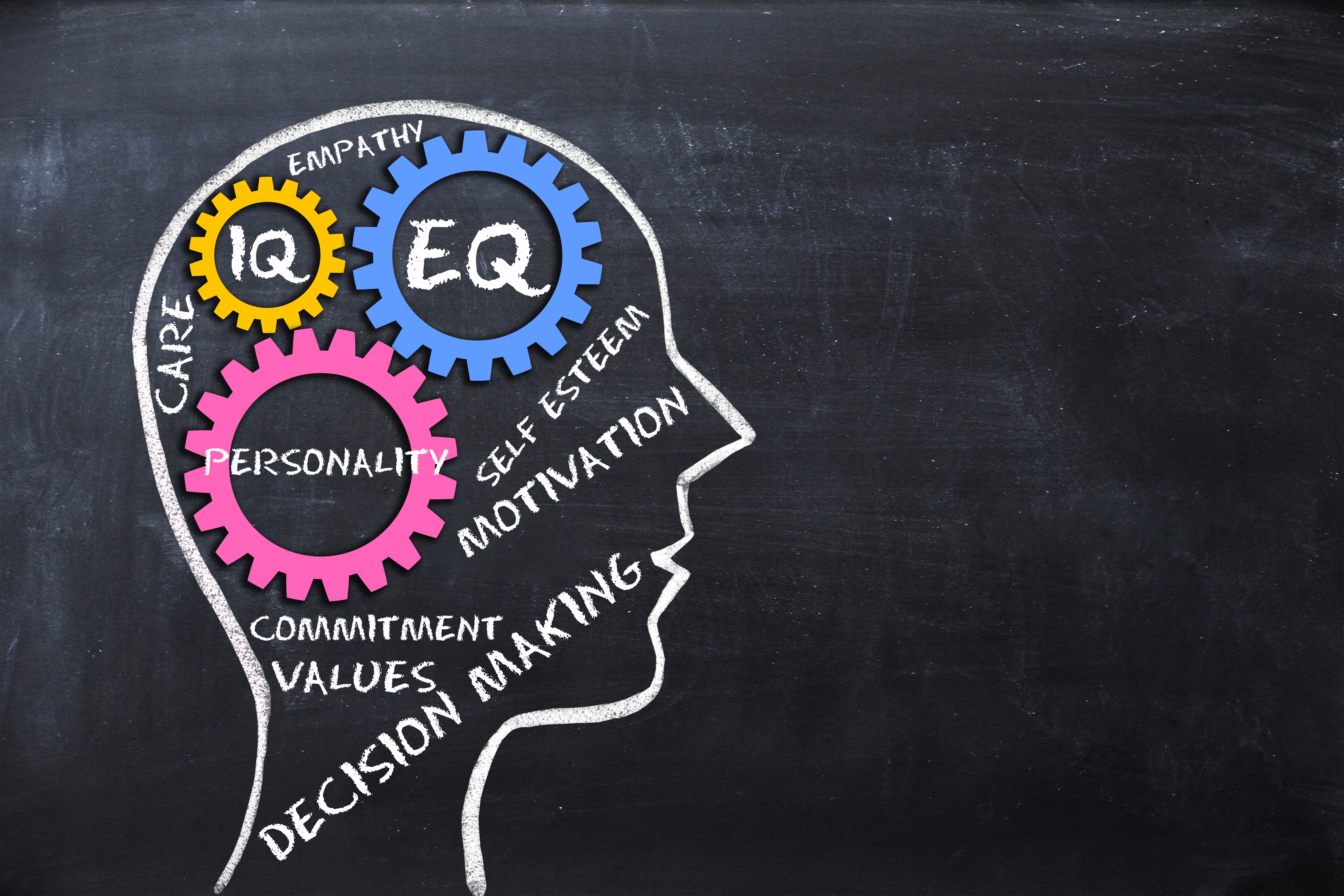
Understanding Emotional Intelligence and IQ
Reasoning through a difficult problem and responding thoughtfully to a colleague’s frustration place different demands on a leader. Comparing emotional intelligence and IQ can help clarify those demands, without reducing people to a single score or assuming one kind of ability always matters more.
What Does IQ Measure?
IQ is a standardized score used to describe performance on cognitive tests. Cognitive ability includes reasoning, acquired knowledge, working memory, and processing speed. Describing IQ as only mental speed leaves out much of what these tests assess.
Cognitive abilities tend to show substantial stability from late adolescence onward, but stability does not mean that an individual’s abilities are permanently fixed. A 2024 meta-analysis examined people’s relative standing over time; that is different from showing that their skills or scores never change. Read the review of cognitive stability.
What Does Emotional Intelligence Mean?
Emotional intelligence, often shortened to EI or EQ, is defined and measured in several ways. In the ability model developed by Salovey, Mayer, and colleagues, it involves perceiving emotions, using emotional information to support thinking, understanding emotions, and managing emotions. Read the researchers’ explanation of the ability model.
Other approaches use self-reports of emotional traits or broader competencies. These measures should not be treated as interchangeable: how people describe themselves is different from how they perform on an emotion-related task. When comparing research or assessments, first ask which definition and measurement approach is being used.
Does EQ Matter More Than IQ at Work?
The research does not justify a universal ranking of EQ above IQ. Relationships with job performance depend on what is measured and which other factors are considered. A 2015 meta-analysis found that self-reported, mixed-model EI was associated with supervisor-rated performance, but that relationship disappeared after the researchers accounted for a set of overlapping traits and abilities. Read the job-performance meta-analysis.
This is a reason to interpret claims carefully, rather than dismiss emotional skills. An association does not establish that raising an EQ score causes a promotion, higher salary, or lower employee turnover. For leadership development, a more useful question is which behaviors someone needs to practice in their role.
How Can Stress Affect Thinking?
The phrase “amygdala hijack” can oversimplify what happens under pressure. A meta-analysis found that acute stress impaired working memory and cognitive flexibility on average, while its effects on inhibition were more complex. The findings do not mean that emotion simply switches rational thought off. Read the review of stress and executive functions.
Can Emotional Skills Be Developed?
Research supports the potential to improve emotional competencies through training. A 2024 workplace systematic review included 50 studies; a separate analysis of 27 controlled studies found an average benefit for the emotional competencies measured. However, the authors reported substantial variation and concerns about study bias. Read the workplace-training review.
These findings support development efforts, but they do not establish that every program produces the same results or that improved assessment scores automatically translate into better business performance. The review is evidence about a range of interventions, not a validation of BlueEQ specifically.
A Practical Starting Point for Leaders
Use the following as a reflection exercise, rather than a scientifically guaranteed technique:
- Notice: What are you feeling during a challenging conversation?
- Check: What assumptions are you making about the other person?
- Choose: What question or response would help you understand the situation?
- Review: What feedback could help you improve your next conversation?
A brief pause may give you space to consider your response. There is no basis in the research cited here for claiming that exactly five seconds resets the brain or guarantees emotional control.
To turn these ideas into workplace practice, explore BlueEQ’s emotional intelligence training for leaders and teams, which connects assessment insights with interactive practice and a personal development plan.
Research Sources
- Breit and colleagues (2024). The stability of cognitive abilities. Psychological Bulletin.
- Salovey, Mayer, Caruso, and Yoo (2009). The positive psychology of emotional intelligence. The Oxford Handbook of Positive Psychology.
- Joseph and colleagues (2015). Why does self-reported emotional intelligence predict job performance? Journal of Applied Psychology.
- Shields, Sazma, and Yonelinas (2016). The effects of acute stress on core executive functions. Neuroscience & Biobehavioral Reviews.
- Training emotional competencies at the workplace: a systematic review and metaanalysis (2024).
